Refugees and Homelessness
Who really cares?

After more than two decades of research and programming in some very fragile contexts, I thought that no situation would shake me.
However, I must admit that I am still reeling from my recent ethnographic study of refugees and homelessness in Canada. For three months, I learnt about the prejudice, stigma, disrespect and lack of care that many who are seeking a safe place still encounter.
Furthermore, I can now say that I deeply understand the shocks that drive many to desperation, including those from families that were once stable. I saw how an unfeeling system compounds hopelessness, particularly when individuals lack family support and are shunned, even by the community, including religious, leaders that they thought would touch them where others refused.
What did we learn?
1. People are not “touched” by systems that value procedures over humanity; the existence of “social support institutions and mechanisms” does not automatically translate to genuine support. Genuine support is not mechanical.
2. Hopelessness and helplessness are compounded where persons are dehumanized by religious and other community leaders who have pre-determined the subpopulations that are more and less worthy to be touched.
3. The label “refugee” masks the true identities of varied groups and subgroups.
(There appears to be an assumption that all refugees are uneducated, unskilled and in need of one pre-determined menu of interventions.)
4. Persons and families who are labelled as “poor” are often lumped as incapable in all aspects. Poverty accelerates when these families begin to believe this of themselves.
5. Societies appear unaware that wealth and stability are not necessarily permanent; there are shocks that can plunge families and individuals to places that they did not envision or desire.
6. Wealth, status and positioning can produce a false sense of superiority; transformation is unlikely where those who are served are treated with the assumption that they are the ‘deserved inferior’.
Here are some key lessons:
▪️ It is difficult to respond to the ground when our only method of interpretation is desk based research and analysis.
▪️It is difficult to respond to needs when we are unable to see, hear and feel people’s desperation.
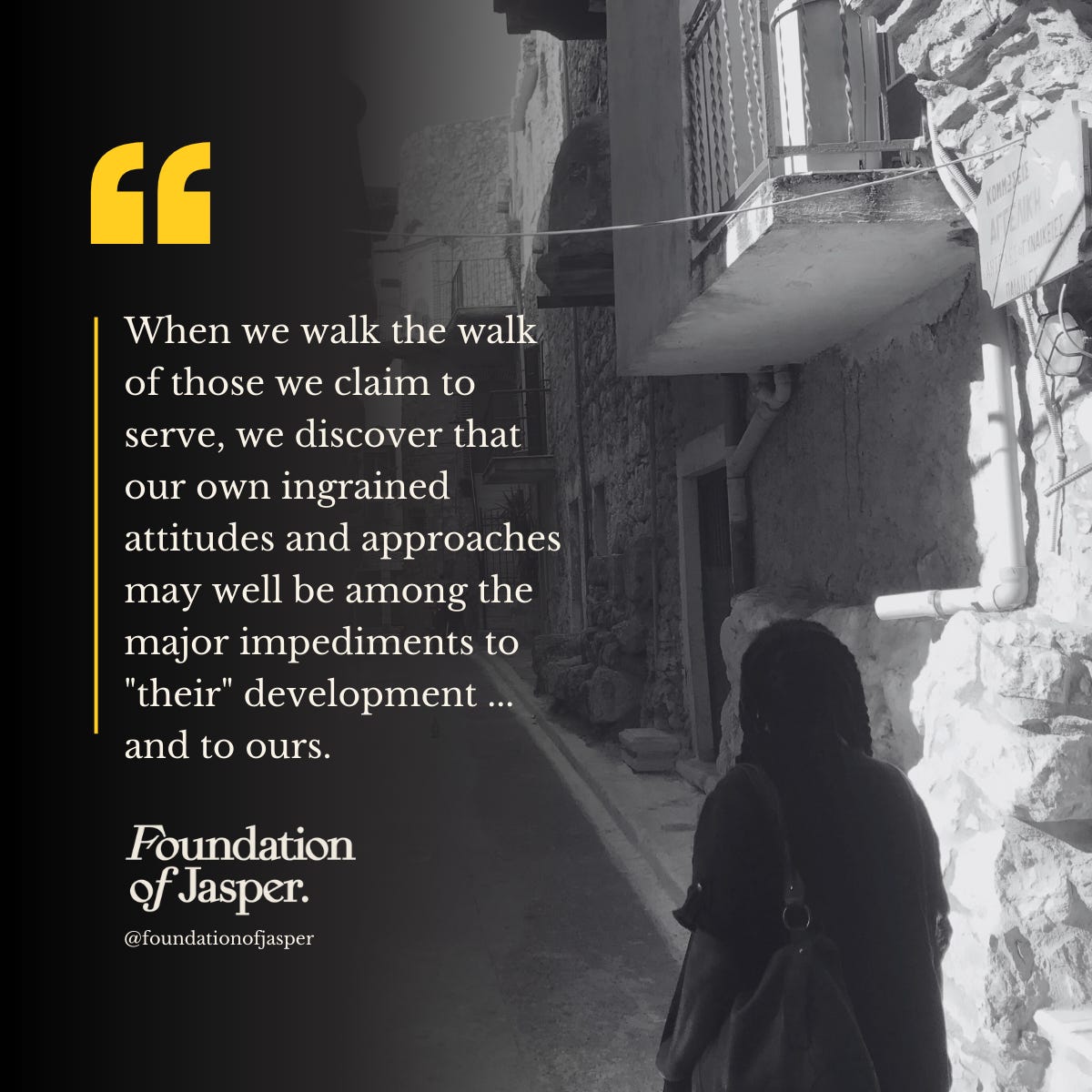
▪️When we walk the walk of those we claim to serve, we discover that our own ingrained attitudes and approaches may well be among the major impediments to “their” development ... and to ours.
Foundation of Jasper has designed transformative interventions based on findings from the ground. The findings have helped us to shape our content and, critically, our approaches.
We look forward to working with partners who are concerned with making genuine, measurable, social impact.